


In my search for interesting subjects for this monthly article, I have support from a long list of enthusiasts with suggestions and introductions. I also attend car shows and seek out owners of the many beautifully restored or customized masterpieces.
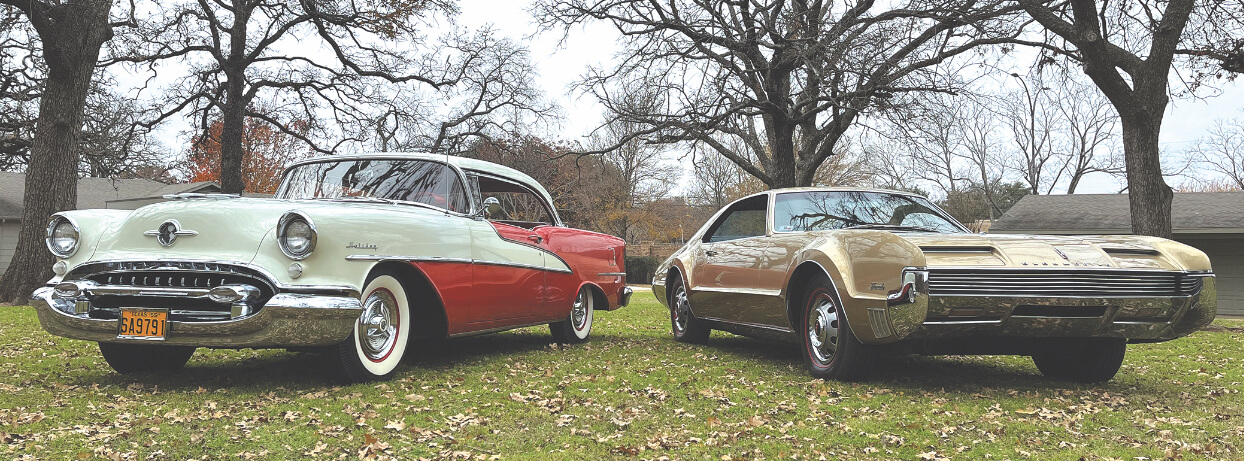
Two weeks ago, I received a last-minute invitation to participate in the HOUSE OF HOTRODS Winter Car Show & Christmas Toy Drive in Mansfield. I decided to take my unrestored 1955 Oldsmobile Ninety Eight Holiday Coupe. This car is one of two Oldsmobiles that I am fortunate to have in my garage. The other is a 1966 Toronado Deluxe, which is also completely original.
Related posts

There were dozens of beautifully restored masterpieces representing countless hours and dollars to make an old car look new or individually unique. Local car shows are always rewarding … examining the craftsmanship and care that goes into rebuilding the car you always wanted as a kid, or to create your vision of the perfect car through often unbelievable custom work. I made several new friends and found subjects for future articles.
It was a rewarding morning, lots of toys for some lucky kids … and I was surprised when the judges awarded my 1955 Olds the trophy for Best Domestic Car. One of the judges told me that restoring and customizing certainly preserves vintage cars, but it is not often that you see a car that is over 70 years old … completely authentic and original, and with only 38,400 miles.
THEY ARE ONLY ORIGINAL ONCE was the phrase that went through my mind. And, throughout my many years in this hobby, I have sought out original cars. Finding a lovingly preserved original is the high point for nearly all collectors.
Having two original Oldsmobiles is special for me because I love the history of the industry, and Olds was the oldest car manufacturer in the country when they ceased production in 2004. The first Oldsmobile automobile was built in 1886 by a pioneering mechanical genius, Ransom Eli Olds, in Lansing, Michigan. Mr. Olds created the first moving assembly line, which was later perfected by Henry Ford. In 1908, he sold his company to the developing giant, General Motors. The brand flourished as GM’s “guinea pig” division. New technical innovations were introduced on Oldsmobile, and if accepted, then it was safe to integrate the improvements into the corporation’s more mainstream brands. By the early 1970s, Oldsmobile was the 3rd largest selling brand in America behind only Chevrolet and Ford. In 1984, sales peaked at over 1,250,000 cars! Just 12 years later, the magic was gone with sales down 70% from the peak in ’84. The last Oldsmobile was delivered in April of 2004.
The 1966 Toronado (mine now with 67,200 miles) was the ultimate example of testing new innovations before corporate-wide adoption. It was the first modern front-wheel-drive car built in America. The entire car was designed and developed around the uniquely packaged engine/transmission power unit that fit entirely under the hood. This eliminated the conventional center hump for the transmission and drive shaft, creating space for six passengers. More importantly, the car won universal praise for engineering excellence and conditioned the public to accept front-wheel drive as a viable design. Today, the vast majority of cars feature front-wheel drive. The Toronado features a powerful 425 cubic inch V8 and a 4-speed automatic transmission mounted side by side under the long hood. The engine crankshaft is tied to the transmission with an oversized “bicycle” chain! Building the engine and transmission into a “power unit” dramatically simplified the manufacturing process while simultaneously increasing the space in the passenger compartment. GM knew that the future would dictate smaller, more space-efficient, and economical cars.
The 1955 model has factory air conditioning and was the first to have the unit concealed with the cold-air vents mounted on the instrument panel.
Both cars were at the top of the Oldsmobile lineup. Separated by a decade, they are radically different. Styling evolved dramatically in the ’50s and ’60s. Today, it is hard to spot the difference between a 2015 and a 2025 … Computer-aided design, focus on aerodynamic efficiency, and the shift away from colors to black, white, and grey makes the rolling landscape far less interesting.
These two cars are remarkable examples of the incredible talent and overall capability of the American automobile industry. Engineering is the key to producing literally millions of virtually perfect yet incredibly complex machines that will last for as long as they are maintained and protected. Driving either of these two is always a treat, and particularly when observers who have never heard of an Oldsmobile learn that all that steel, paint, glass, and chrome is not new … They are only original once.