
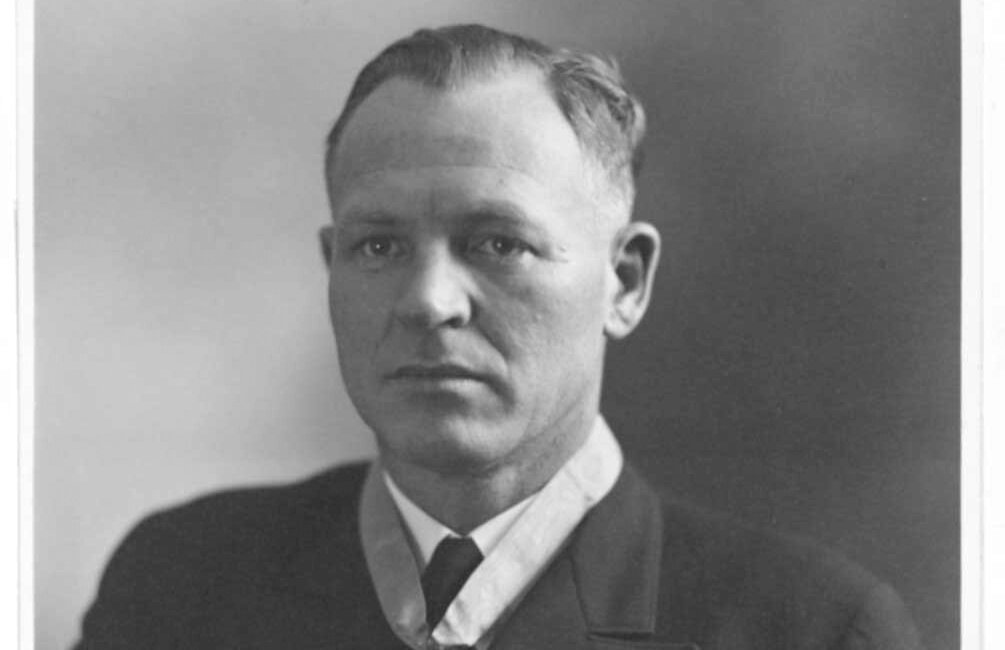

William Badders grew up far away from the ocean from which he would one day save lives. Born in Harrisburg, Illinois, Badders grew up in Terre Haute, Indiana. He enlisted in the Navy a month before his 18th birthday in 1918. During boot training at Great Lakes Naval Training Center, Badders was selected to become a fireman third class, a lucky selection that influenced the course of his naval career.
On his first assignment aboard the battleship USS Wisconsin (BB-9), a sailor gave Badders some advice—when the time came to fill out the forms to be placed on the ship, tell them he had mechanical training. Otherwise, he would spend his time on the ship shoveling coal. The trick worked, and Badders was assigned to the engine room division and soon began to learn more about engineering. Aboard Wisconsin, Badders was a part of patrols in the war zone, just enough experience to make him eligible for a World War I Victory Medal.


After the end of the war, Badders requested to train as an aviation mechanic. Approved, he traveled to the Naval Air Station at Pensacola, where he spent two years working in aviation and playing football and baseball with the Navy. Badders’ next stop was USS Kansas (BB-21). After a midshipmen’s cruise, orders came for Kansas to be decommissioned. As part of her crew, Badders was given preference for his next assignment. He had learned about the Naval Academy from the midshipmen and requested duty aboard the station ship Reina Mercedes there.
At the end of his original enlistment, Badders re-enlisted in the Navy. After duty at the Naval Academy, Badders was assigned to USS Falcon (AM-28), a salvage ship. Salvage ships in the Navy carried specialized equipment for diving operations. Despite having some of the necessary equipment onboard, Falconhad no divers in the mid-1920s. The Navy had cut dive training after World War I, and few men had any experience with the dangerous work.
Badders underwent some very basic dive training and, in 1926, participated in the salvage operations to recover the submarine USS S-51, which sank off Block Island, Rhode Island. A merchant steamer rammed the submarine in 1925, and it quickly sank. Only three of the 36-man crew survived. Working as part of the salvage crew, Badders volunteered to climb aboard pontoons in rough seas. The pontoon chains had broken and separated from the sunken submarine. Risking his life, Badders climbed aboard the pontoons to manually open valves which allowed seawater in so that they could flood and sink again. For his bravery, Badders was awarded the Navy Cross.
The next year, another submarine, USS S-4, was rammed by a Coast Guard ship and sank. Badders once again participated in the rescue and salvage operations. Bad winter weather thwarted rescue attempts, and all 40 hands aboard the submarine were lost. These two disastrous sinkings, just years apart, reignited the need for trained, skilled Navy divers as well as better crew rescue equipment. In 1928, the Naval School, Diving and Salvage, was established, and Badders graduated with the group as a first-class diver. He stayed on as an instructor until June 1930.
Badders’ next assignment was again on USS Falcon, this time working with a team to test and improve rescue equipment like the Momsen Lung and McCann Rescue Chamber. In 1936, Badders received orders to join the Experimental Diving Unit at the Washington Navy Yard. Badders participated in developments in underwater welding, breathing mixtures (adding in helium to oxygen), and dive tables. He also made groundbreaking test dives to better understand just how far divers could safely descend and work.
On May 23, 1939, Badders received word that another submarine had sunk. This time it was USS Squalus (SS-192), out on a test dive after commissioning. A faulty valve allowed seawater to flood the engine room, quickly leading to a catastrophic scenario. As the boat flooded, power was lost, and 33 men were trapped in the forward half of the submarine. They were unsure if the 26 men in the aft part of the submarine were still alive.
Rescue operations began the next day using the McCann Rescue Chamber. In the chamber, two divers descended to the submarine, where they attached the chamber to a hatch. Seven men then moved into the chamber, the hatch was closed, and the chamber ascended to the surface, where the survivors went aboard another ship. Badders was selected for the second dive. Realizing he had the most experience with the chamber, he chose to bring up nine men instead of seven to reduce the overall number of trips needed.
Badders brought up another nine on the next dive, rescuing 18 in all. After the fourth dive by others to retrieve the final crew, Badders and fellow diver John Mihalowski were given the most dangerous assignment yet. They descended to the submarine and connected the rescue chamber to the hatch over the after portion of the boat. If something went wrong, they would not be rescued. After letting the pressure in the chamber equalize to that of the 240-foot depth of the submarine, Badders began to open the hatch. No one knew if they would find anyone alive. As the hatch cracked open, water rushed into the chamber. Badders quickly shut and sealed the hatch. There would be no more survivors taken to the surface.
Over the next several months, Badders took part in the salvage operations. USS Squalus was finally put into a dry dock in September 1939. The next year, it was fully reconditioned and put back into operation as USS Sailfish. The boat completed 12 patrols during World War II. Badders and Mihalowski were awarded the Medal of Honor in January 1940, along with fellow Squalus divers Orson Crandall and James McDonald.
Badders transferred to the Fleet Reserve at the end of 1940 to work as the master diver-salvage master on the Panama Canal. He spent the duration of World War II at the Canal, ensuring it would stay operational in the face of possible sabotage or accidents. He retired in 1962 from working on the Panama Canal at the age of 62, and only then did he stop diving.
Kali Schick is Senior Historian at the National Medal of Honor Museum