



Arlington has much to celebrate in 2026: The inaugural Java House Grand Prix of Arlington in March, nine FIFA World Cup matches in June and July, and, perhaps most meaningful of all, Arlington will celebrate its 150th birthday.
This sesquicentennial celebration is a chance for our community to look towards the future with hope and vision for the next 150 years. It will be a time for us to look back, to see where we’ve been and how we became the amazing city we are today.
As we’ve talked about what we might do in 2026 to celebrate this civic occasion, I’ve been curious about past milestone celebrations. Records are elusive for the bicentennial in 1926, and, while I won’t call 1976 the prehistoric (that would be very rude indeed), I will still say that records are scarce.
Call it synchronicity, fate, or simply spending far too much time immersed in all things Arlington, but a few artifacts from the Centennial Celebration have found their way into my hands over the past year.
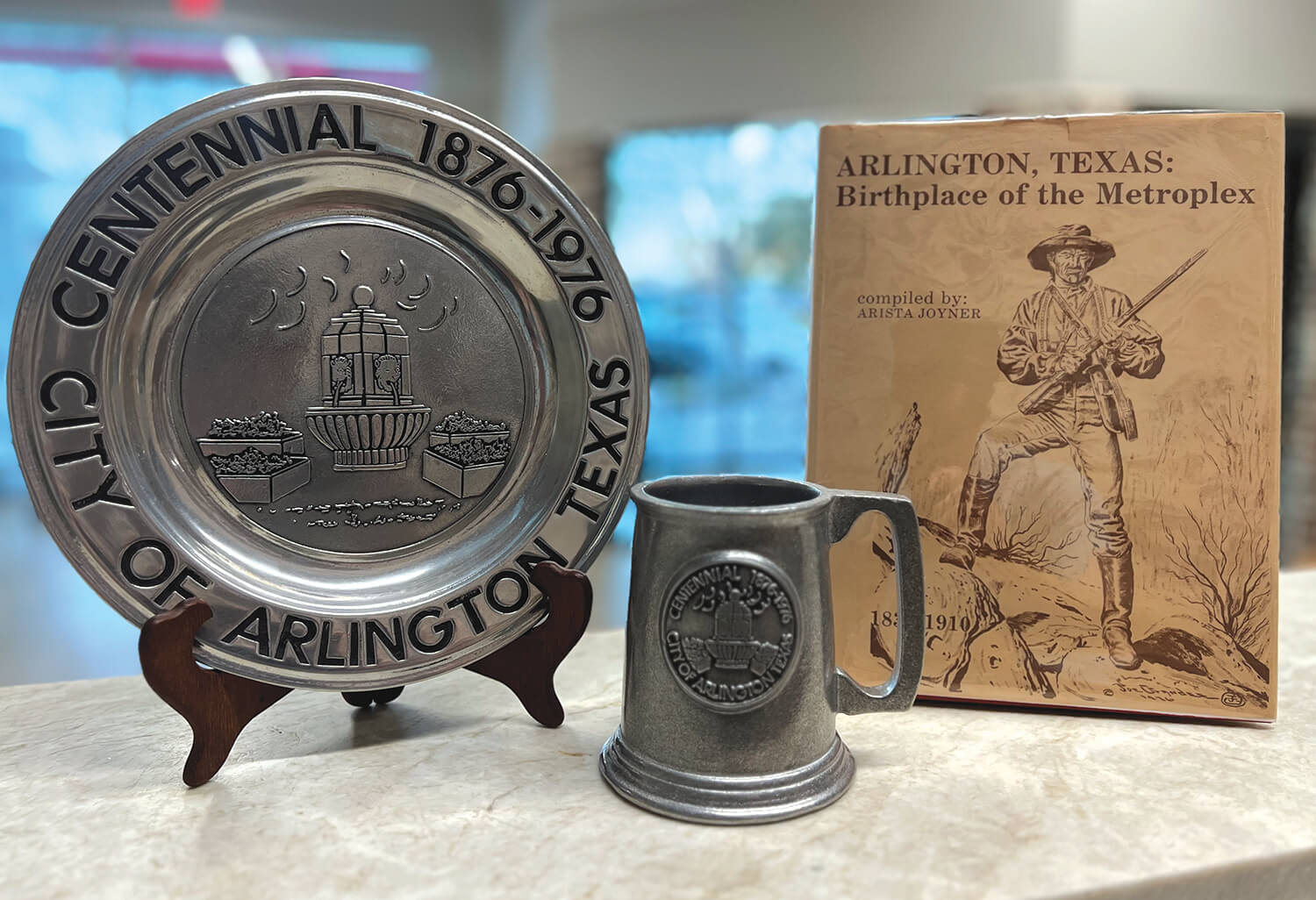
Some may have caught wind of a remarkable estate sale back in December at a Downtown storefront, filled with Arlington memorabilia. The owner of that wonderful collection of old junk is a friend of mine, Virgil, whose dad owned the Curtis Mathes TV Store back in the day. While going through his treasures in preparation for the sale, Virgil brought some of his artifacts to our office (pictured).
This pewter mug may make for a better self-defense weapon than a drinking receptacle, but I found the inscription quaint. The plate, marked Limited Edition on the back, probably contains lead above modern manufacturing standards, but I was grateful nonetheless. These items felt like a pure representation of community pride from a bygone era of small-town Arlington.
My penchant for Americana antiques was piqued, but little did I know that I would stumble upon yet another special Arlington artifact.
While searching for Christmas presents for the innumerable kids in our family at Half Priced Books, I stumbled upon a rare find: a copy of Arlington, Texas: Birthplace of the Metroplex by Arista Joyner. Priced at $50, it was far too rich for my taste (hence why I shop at HPB), but I could not stop thinking about the book. I eventually went back and purchased it, and I’m glad curiosity won out. I was surprised to find that the book was a relic of the Centennial, created in 1976 in coordination with the Arlington Bicentennial-Centennial Celebration Committee, which is quite a mouthful.
With relics in hand, I set out to learn how we celebrated these occasions and what life was like in Arlington in 1976. At that time, we were at a turning point in our history. The population was in the midst of nearly doubling, rising from 89,723 in 1970 to 160,123 in 1980. Tom Vandergriff was nearing the end of his 26-year run as Mayor. Arlington was the quintessential ‘boomburb’, expanding in suburban sprawl to the south and east. The Rangers had just made Arlington their home, and the DFW Airport was the new center of gravity for the Metroplex.
The Arlington Bicentennial-Centennial Celebration Committee came together to plan the celebrations. Arlington leader Carolyn Snider took the mantle as the Chair, and the committee quickly began organizing the celebrations.
Snider assigned committee member Arista Joyner to the creation of an Arlington history book. Joyner wasn’t from Arlington, but she was one of many transplants who had brought good ideas to the table and was promptly put to work. The resulting book, of which I am now a proud owner, chronicles the early days of Arlington, from 1838 to 1910. Many passages paint a picture of the times with news from the region and milestones of the nation. But the most interesting tidbits to me are the portions that still reverberate today, like the entry in 1853, stating “Patrick A. Watson to build a two-room log house with a runway between the two rooms”. The P.A. Watson house is, of course, displayed today at the Knapp Heritage Park on Front Street.
The Mineral Well has always been a signal of Arlington’s spirit and community. Adorned with two lion heads originally in 1910, the well had long since closed by 1976. The committee reopened the well with a drinking fountain and several columns, sponsored by the Vandergriff family.
The memorial also contained two time capsules to be opened in 2076. Those were later moved to the Founders Plaza. Many attendees at the Levitt Pavilion would never know that there is a 50-year-old time capsule under The Gift, the sculpture of the man playing the guitar by Seth Venable.
As we enter our 150th year, I encourage you to deepen your community involvement. Explore Arlington history at the Fielder House, Knapp Heritage Park, or many historical markers across the city. Explore new businesses, supporting your neighbors by shopping small and thinking locally first. Help envision the future by taking part in Arlington’s Comprehensive Planning process, laying the foundation for the next 50 years. Because Arlington’s next chapter won’t be written by history alone – it will be written by all of us.
Be on the lookout for details from the City of Arlington and Downtown Arlington social media for how you can get involved in all the celebrations and special events planned for 2026.