

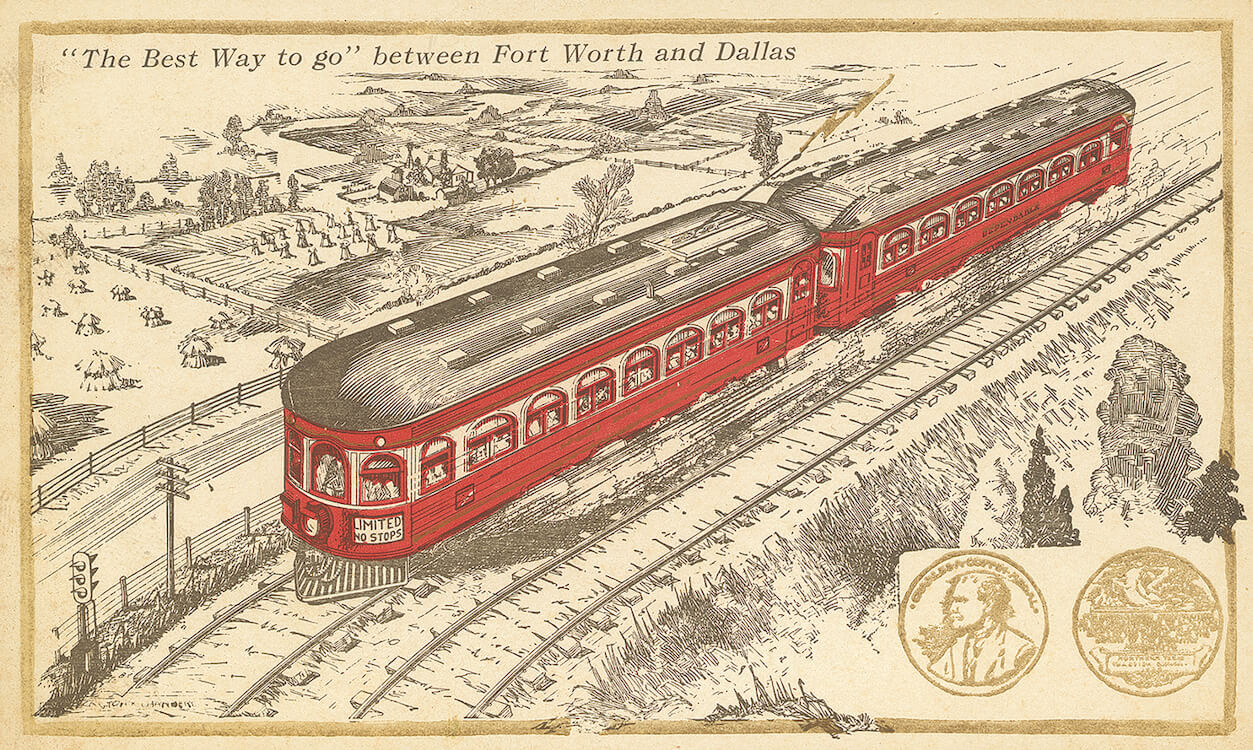

Imagine Arlington in 1900. A new century had arrived, and nearly 25 years since its founding, the population was finally poised to cross the threshold of 1,000 people. The railroad brought the world through the center of town, the mineral well became a tourist draw, and cotton was king. A small town was starting to develop and carve its identity. Though traveling by horse and steam railroad was still standard, the future of travel was here: the Interurban.
But what was it?


The Interurban cars ran on tracks connected to overhead electric wires; they looked similar to a trolley car but were sturdier and able to go much faster, especially between towns. Most roads at the time were rough dirt paths—disastrous when it rained—so utilizing their own tracks kept the cars running reliably. They were popular for regional travel, quick jaunts across town, and with commuters—especially traveling salesmen known as ‘drummers,’ who used them to visit multiple sites or towns to ‘drum up’ business. A cross between a high-speed railroad and a friendly neighborhood trolley, the Interurban led to a massive construction boom: the cars and tracks themselves, power plants (and reservoir water sources) to operate them, businesses catering to passengers, and other operations wanting to be near the action.
In 1901, Texas saw its first Interurban track—a 10.5-mile stretch connecting Sherman and Denison in Grayson County. Proving efficient for riders and profitable for operators, the network quickly expanded.
The Interurban track connecting Dallas and Fort Worth began operations in June 1902. In Arlington, the track went directly down the middle of Abram Street with several stops. There was a time when the street saw pedestrians, horses, Interurban cars, and early automobiles all competing for space.
Abram Street became a popular thoroughfare, and houses there were a hot commodity for their easy access to the Interurban, visibility to passersby, and connection to a new wave of adventure. Cutting through the heart of Downtown Arlington, the Interurban became a part of daily life for many. There were established stops, though motormen would often slow down and pick you up if you flagged them down. Outside of crosstown jaunts, it was used for travel between towns, bringing people to Arlington’s mineral well, and in later years, the Arlington Downs horse racing track, among other local attractions.
Interurban usage became common, and often preferred over the steam railroad, because it offered convenient stops and more frequent service. The rides were generally inexpensive, comfortable, and quieter, devoid of the soot, smoke, and screeching wheels so common on the nearby steam trains. Texas soon had nearly 500 miles of Interurban track, centered mostly in the Dallas-Fort Worth area. Welcomed with feelings of progress and optimism, an exciting new way of transport had arrived.
To power the cars, the Northern Texas Traction Company built a main power station and a man-made reservoir in Handley, just west of Arlington in present-day Fort Worth. Becoming known as Lake Erie, it served a dual purpose: providing cooling water for the plant and serving as a popular recreation destination.
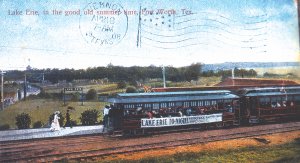
Though the Interurban was used heavily during the week, ridership dropped on weekends. Operators sought new revenue sources, and Lake Erie, along with places like it, became the answer and an attraction unto themselves. Not only did Lake Erie offer a place for picnics and scenic views, it featured a large pavilion with a roller-skating rink, rides, and a restaurant. There was also a floating pier, complete with a boardwalk and a dance hall for music. Boating and swimming were equally common. A mixture of a resort and amusement park, it was a popular and easily accessible weekend ritual. Many from Arlington and the surrounding area flocked to Lake Erie for recreation and social events—almost as a microcosm of today’s Downtown or Entertainment District.
Initially popular, Interurban usage peaked in the early 1920s. The final Interurban car rolled through Arlington on Christmas Eve 1934, replaced by bus service. Elsewhere in Texas, the Interurban pressed on, lasting until 1948, when the last one ran from Dallas to Denison. The rise of the personal automobile, along with improved roads, prompted a sharp decline in ridership, accelerated by the economic hardships of the Great Depression. Conversely, as Interurban usage declined and eventually ceased, so did the recreation at Lake Erie. The lake remained a water supply for the power plant until it was eventually drained following the completion of Lake Arlington in 1957.
After Interurban service ended, much of the steel rail was left in place until the onset of World War II, when it was salvaged, dug up, and repurposed for scrap to support the war effort. Very little evidence of it remains in Arlington; while there are traces still lingering, they’ve been nearly overtaken by time, progress, and nature. However, Fielder Museum—home to the Arlington Historical Society—has an actual, restored Interurban wait station (similar to a waiting room) as part of its collection. Originally located on Abram Street near one of the former stops, the wait station now faces the street and watches automobiles go by, as opposed to people watching the Interurban cars. Times have changed.
The Interurban remains a significant chapter in Arlington’s history and local transportation. Though from a bygone era, what would you think about Interurban cars being used in Arlington today?