
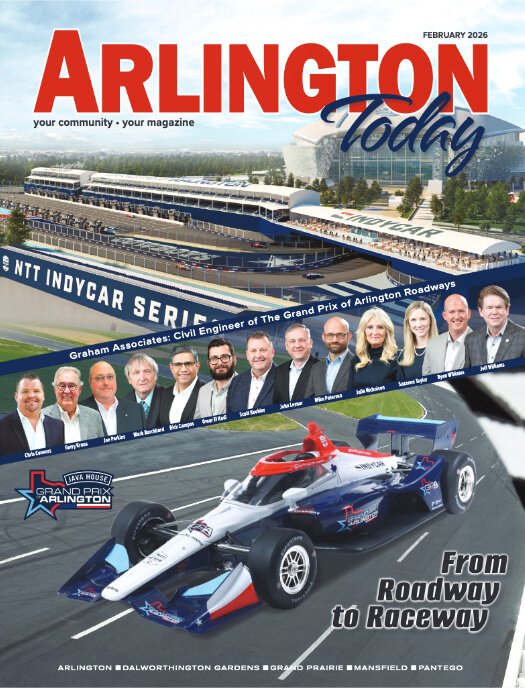

Jeff Williams understands Arlington from both the boardroom and the street level. A professional engineer, businessman, and former politician, Williams served as the 30th mayor of Arlington, Texas, helping guide the city through a period of significant growth and infrastructure development. So when the roadways he helped design along Randol Mill Road, originally intended for everyday city traffic, were selected as part of the course for Arlington’s INDYCAR Grand Prix, the moment carried both professional pride and technical gravity.
“It is extremely exciting when you design a road that was engineered for a 45-mile-an-hour design speed, and suddenly we hear that there are going to be Indy race cars going 195 miles an hour down Randol Mill Road,” Williams said. “My first thought was, my goodness, how is this going to work?” For Williams, a civil engineer whose career centers on public infrastructure and building communities, the transformation of a familiar roadway into a global motorsports stage represents more than a high-profile event. It reflects years of planning, technical foresight, and leadership decisions that now extend far beyond daily transportation needs. The district has now become a premier destination attracting world-class events such as the Grand Prix of Arlington, followed by the World Cup a few months later.
Related posts
Once the Grand Prix concept became a reality, roadway design shifted from long-term municipal use to short-term, high-performance demands, with safety at the center of every decision. Modifications were required to accommodate the physical realities of INDYCAR racing, including changes to surface materials, medians, and protective infrastructure. The event is a joint venture between Penske Entertainment, REV Entertainment, and the Dallas Cowboys. The partnership has been working closely with the City of Arlington to construct and/or modify the infrastructure to provide for a safe and exciting event for everyone. They have created a 2.73-mile raceway with 14 exciting turns!
Among the most visible changes was the removal of traditional asphalt in key areas, replaced with concrete paving to support pit lane operations. Raised medians were lowered and integrated directly into the roadway, allowing safer crossings and greater flexibility for race logistics. Stamped concrete has replaced brick pavers in the crosswalks to avoid the bricks being dislodged by the vacuum created by the race cars being low to the ground, traveling over them at high speeds. Even elements often overlooked by the public, such as manhole covers, have been bolted down to ensure they remain secure at racing speeds.
Beyond the technical details, Williams sees the Grand Prix as an opportunity for Arlington to showcase how public infrastructure can serve multiple purposes, from daily community use to international events that draw visitors and investment into the region. “It is extremely exciting to think that our roadways are going to be able to be used here for such an exciting thing, to bring in so many visitors from around the country,” he said. “But also to bring in OPM, other people’s money, to bring in tax revenue, and provide more customers for our local businesses! It has been a great thing to have OPM coming into Arlington to help pay for city services and keep our taxes down.”
For Williams, the most rewarding outcome is not the speed or spectacle, but the human impact. Roads designed for function are now creating special places for families, visitors, and communities to come together. “As a civil engineer who designs public infrastructure, it is very rewarding to see our facilities be used,” he said, “to see people enjoying themselves, families coming together, and friendships being forged.” As Arlington prepares to welcome a global motorsports audience, Williams sees the Grand Prix as a moment when the city’s identity becomes visible to outsiders and reaffirmed for those who call it home.
“It’s very exciting that we are going to have a world-class event like the Grand Prix coming into our community,” Williams said. “People are able to see what our community really has to offer.” That visibility extends beyond the racetrack. Williams emphasized that large-scale events offer cities an opportunity to showcase the places, businesses, and public spaces that define everyday life in Arlington, from downtown corridors to River Legacy Park and the Entertainment District. Hosting an event of this scale, he noted, requires years of intentional planning and investment in infrastructure that supports both residents and visitors.
“You’ve got to be thinking about creating special places in your city so that you can even have the opportunity to host these world-class events,” he said. From Williams’ perspective as a civil engineer, infrastructure is not just functional. It is foundational to how communities grow, connect, and sustain themselves over time. Projects like the Grand Prix highlight the often unseen work engineers do to balance safety, accessibility, and long-term use while still allowing space for innovation and spectacle.
“Civil engineers create, build, and design infrastructure, but we also work to create special places people want to be, and to ensure their safety,” Williams said. Nowhere is that philosophy more evident than in Arlington’s Entertainment District, an area Williams describes as a living example of how thoughtful engineering supports diverse forms of community engagement. The district brings together professional sports venues, a major amusement park, Six Flags over Texas, museums such as the National Medal of Honor Museum and the Arlington Museum of Art, trail systems, recreational spaces, and emerging industries like esports, all within a single interconnected environment.
The scope of engineering involved designing a transportation network, utility engineering, pedestrian and cycling trails, stormwater and lake engineering, bridge design, and site planning/engineering. According to Williams, these elements collectively shape the character of a community and influence how people experience it. “I hope when people go to this event that visitors recognize what a special place Arlington is,” he said. “And I hope our residents look around and are proud of what has been accomplished here and the opportunities we have as Arlington citizens.”
Williams is extremely proud of his Graham team that designed infrastructure that has been resilient and a catalyst for the large growth of the District, while adding character to our Community. From the award-winning project, The Three Bridges on I.H. 30 traveling south to Cowboys Way, you will experience a special place, which is attracting over 16 million visitors per year. The collaboration and teamwork between the City of Arlington, North Central Texas Council of Governments, Texas Department of Transportation, property owners in the district, and Graham Associates was a major factor in the success of the projects in the Entertainment District.
“We’re at the beginning of a technology revolution,” Williams said. “Leaders have to encourage people to embrace change, find solutions, and move ahead.” For Williams, the Grand Prix is also a teaching moment, one that illustrates how infrastructure can evolve far beyond what designers initially imagine. When asked what advice he would offer to emerging leaders in engineering and urban development, his focus turned immediately to learning, curiosity, and perspective.
“I would encourage emerging leaders to study and learn as much as they can,” Williams said. “Travel around the country and around the world to see great projects, and be willing to seek out successful leaders who have gone before them.” He emphasized the value of mentorship, noting that learning from those with lived experience accelerates growth in ways textbooks cannot.
Equally important, he added, “You must be willing to listen to people and find out what they want. Ask the right questions to understand their needs before you start designing.” That listening process, combined with a deep understanding of site conditions and long-term goals, allows projects to evolve organically. Williams stressed that effective infrastructure design requires engineers to think beyond the immediate task and consider how their work connects people to larger experiences.
“I’m not just designing a roadway into a building,” he explained. “I’m designing the access that will lead people into the National Medal of Honor Museum.” That big-picture mindset, he said, is what transforms functional infrastructure into something meaningful. By keeping users in mind and prioritizing safety, accessibility, and innovation, engineers can create spaces people genuinely want to engage with. Williams cautioned that vision must be matched with attention to detail, noting that even small decisions can determine the success of large-scale projects. “Make sure you take care of the details,” he said. Reflecting on the broader message he hoped readers would take away, Williams returned to the profession at the heart of the Grand Prix transformation. “Civil engineers build communities,” he said. “We also create special places, and we do that through innovation, collaboration, and teamwork.”
For Williams, the success of projects like the Grand Prix is never the result of a single decision or discipline. It is the product of teams working together across sectors, blending technical expertise with civic vision to create infrastructure that serves people in ways both expected and unforeseen. “We use teamwork and innovation to be successful,” he said. What began as streets built for daily life now carry Arlington’s identity onto a global stage, proof that when leadership and collaboration align, even the familiar can become extraordinary.