

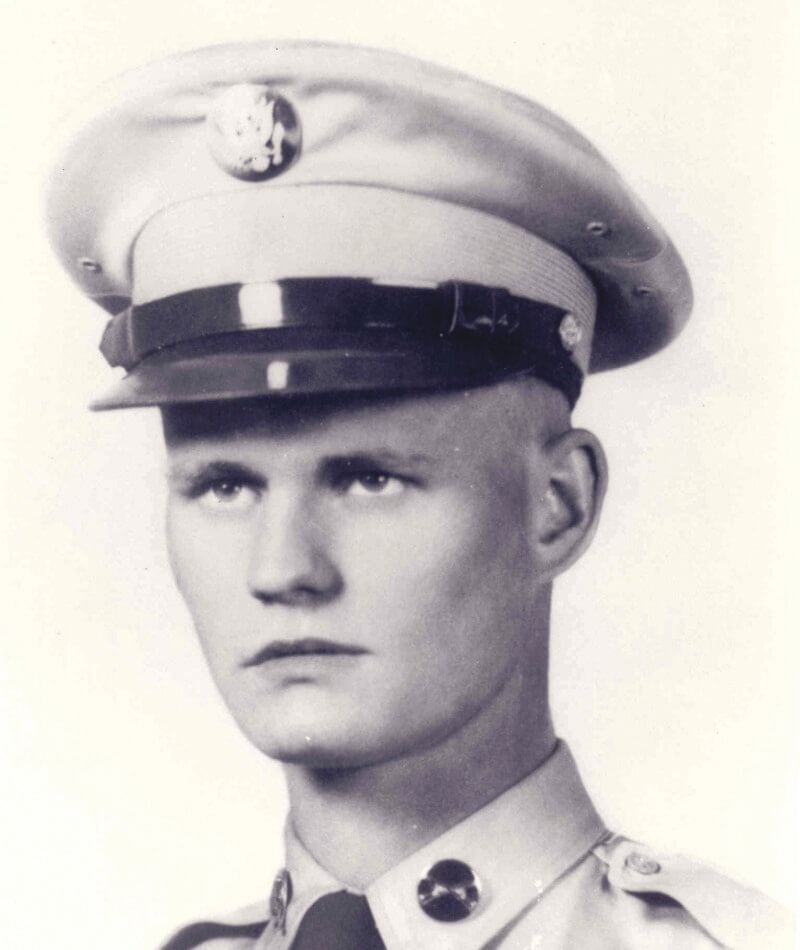

Of the more than 3,500 Medals of Honor awarded, more than 600 have been given posthumously. Almost 100 service members were posthumously awarded for their actions during the Korean War. The youngest of them is Charles Gilliland.
Born near Mountain Home, Arkansas, on May 24, 1933, Charles Leon Gilliland was the eldest son of nine children born to Leon and Margarite. Growing up in rural Arkansas, Gilliland loved to spend time outdoors hunting and fishing. To exercise, he often took long walks with one of his younger siblings on his shoulders. Unable to afford weights, he lifted large stones and even an anvil to build muscle. Gilliland was not yet a teenager when World War II ended, but he was already drawn to police work and military service. He collected military stories, photographs, and war surplus gear when he could afford to buy it. Combined with his love of the outdoors and physical fitness, he naturally turned his attention to joining the military.


When he turned 16, Gilliland asked his parents for permission to join the Army. Despite his desire to serve, he was too young to enlist even with parental consent. The next year, Gilliland’s parents consented, allowing him to enlist on his seventeenth birthday in 1950. Barely a month later, the Northern Korean People’s Army invaded South Korea, beginning a war that lasted three years.
After basic training, Gilliland, as a private first class, shipped out to the Pacific with Company I,
7th Infantry Regiment, 3rd Infantry Division. Despite being of average height and build, Gilliland stood out among his fellow soldiers. In addition to his issued weapon, he wore a pistol belt with two pistols. Gilliland was also known to rarely remove his helmet, around which he wore a belt of .30 caliber machine gun ammunition. Even while in rear areas or during a casual softball game, Gilliland could be seen with his “steel pot” helmet atop his head. His unusual habits earned him the nickname “Gunsmoke.”
The 3rd Infantry Division arrived in North Korea in November 1950. Over the next three months, all Allied forces were pushed south, beyond the 38th Parallel. Gilliland wrote home when he could. A few months into combat, he wrote to his family about carrying to safety a wounded soldier who had lost both legs.
In late April 1951, Chinese and North Korean forces began a spring offensive, pushing west to capture Seoul. General Matthew Ridgway had replaced General Douglas MacArthur as the commander of the United Nations forces. Gilliland’s company dug in around Route 33, a national highway near Seoul. It served as a main supply route for American forces, which made it a key target for the Chinese. On April 24, a large force of Chinese troops attacked the American battalions. During fierce fighting, the Chinese forces broke through the American lines.
The next day, American forces began to withdraw to the south. Fighting through roadblocks, Gilliland’s company came up against fierce resistance. When his assistant gunner was killed, Gilliland kept pouring steady fire into the Chinese lines and stemmed their onslaught into his line. When two enemy soldiers broke through his line of fire and breached his sector, Gilliland jumped out of his foxhole and killed them both with his pistol. Around midnight during the furious firefight, Gilliland was struck in the head by enemy fire. Mortally wounded, he was carried to the top of a ridge line with the other wounded. At the top of the ridgeline, Gilliland’s company regrouped and prepared to withdraw. Exactly what happened to Gilliland as his unit withdrew would never be determined.
Chinese forces occupied the ridge where Gilliland was last seen on a stretcher. Some soldiers thought they had seen South Korean soldiers carrying his stretcher, but he was never accounted for. His family was told he was missing in action. Despite never being listed on any Red Cross prisoner of war rosters, the Army was reluctant to declare him dead until they could undertake a full investigation.
For his actions on the night of April 25, Gilliland was initially recommended for the Distinguished Service Cross. It was upgraded to the Medal of Honor, but the award was withheld and not publicly announced in the event that Gilliland was a prisoner of war. Just as they had chosen to do with Hiroshi Miyamura, the Army kept the award secret so that neither man would face harsher punishment in a prison camp. But unlike Miyamura, Gilliland did not survive his Medal of Honor action.
The war in Korea ended in July 1953. With all prisoners of war returned to the United States, the Army began to investigate those who were unaccounted for. Among them was 17-year-old Charles Gilliland. Extensive interviews with others in his unit and surrounding units led investigators to believe he had had no chance of surviving his wounds. The area in which he was last seen was searched for any sign of a burial. Local farmers were interviewed for any clues. Despite months of searching and countless interviews, Gilliland’s remains were never recovered. He is one of approximately 7,500 Americans still unaccounted for from the Korean War.
In December 1954, Leon Gilliland accepted his son’s Medal of Honor. Killed in the line of duty just one month before he turned 18, Charles Gilliland was the youngest Medal of Honor Recipient of the Korean War.
Kali Schick is Senior Historian,
National Medal of Honor Museum
Charles Gilliland in 1950 
Image courtesy of the U.S. Army