


For Linda Cunningham, the end of work was the beginning of wonder
Some people retire into the couch.

They sink into the cushions with a remote in one hand, iced tea in the other, the rhythm of daytime television replacing the rhythm of deadlines and those dreaded alarm clocks. They say things like, “I’ve earned this,” and they’re not wrong.
But then there’s Linda Cunningham.
Retirement, for Cunningham, is not a landing place. It’s a launch.
While others scroll through streaming menus, she scrolls through airline routes. While some retirees measure time in episodes watched, Cunningham measures it in passport stamps and boarding passes. While some call it her academic curiosity – she was, after all, during her working days, a pathologist and educator – she corrects them with “travel curiosity,” and says so with the kind of spark that makes you lean in a little closer.
For decades, her life was structured by responsibility — work schedules, meetings, calendars filled with autopsies, and later teaching medical students and residents. Travel was something squeezed between obligations. She saw places, sure, but always with an eye on the return date.
Full retirement in 2022 changed all that.
Now there is no clock ticking in the background. Just an open calendar and a world map.
And she is using it.
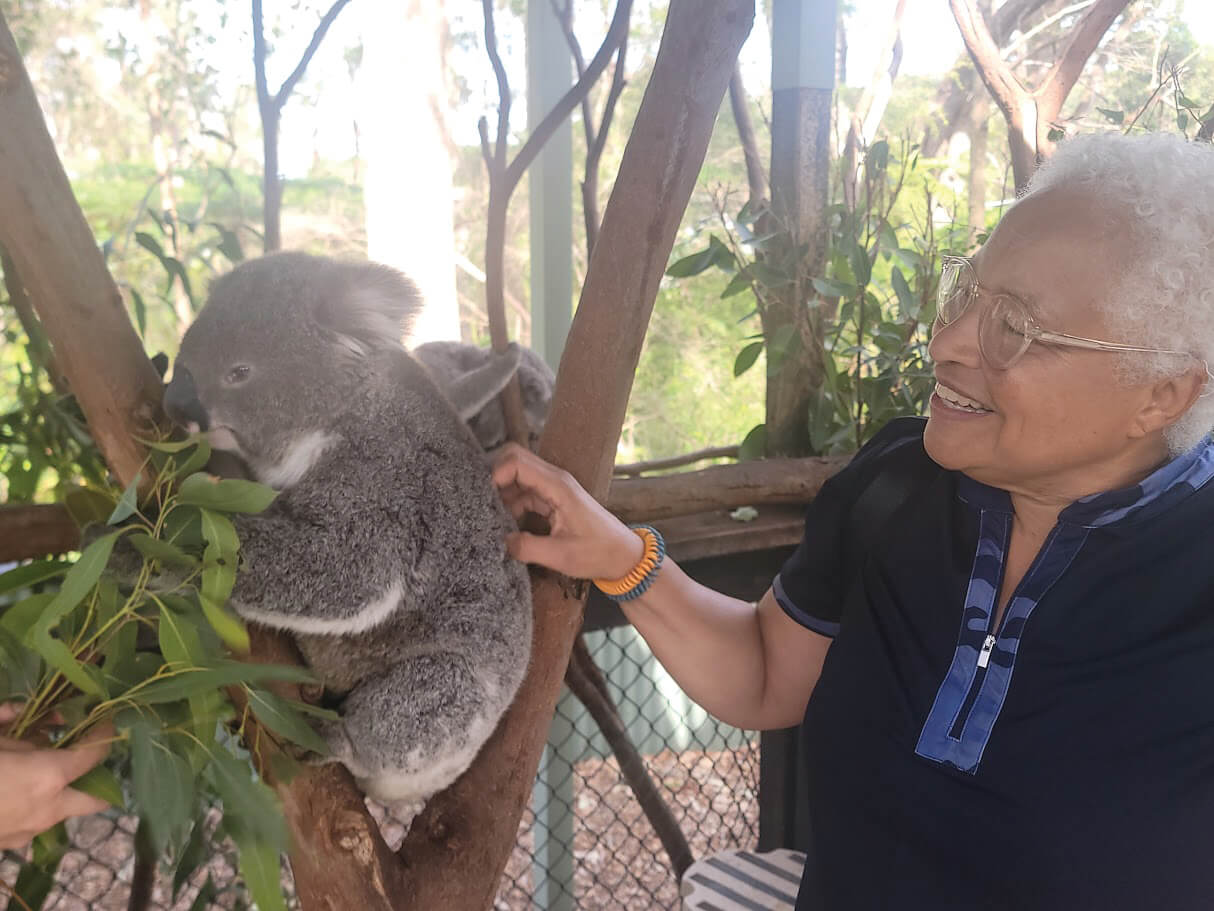
In the past few years, Cunningham has been so close to free-roaming lions she could touch them. She’s seen the birthplace of Jesus, strolled through the Jordan River, spoken with tribal elders in villages in Fiji, braved Iceland, and hung out with koalas in Australia. She read about the Serengeti in Tanzania as a young girl, and now her boots have been on the soil.
That uncertainty, she says, is the point.
Speaking with Cunningham by phone, I noticed something quietly rebellious about her vibe. Retirement in American culture often comes packaged with images of rest — porch swings, golf courses, quiet routines. And there’s nothing wrong with that. But Cunningham seems to see rest not as a destination but as something that happens naturally between flights.
She doesn’t travel to escape her life. She travels to expand it.
Friends sometimes ask if she ever feels tired of moving, of packing and unpacking, of navigating airports and train stations. She laughs at that.
“I was tired when I was working full-time,” she said. “This is different. This energizes me.”
Travel, for Cunningham, isn’t about luxury. It’s about exposure. She wants to understand how other people live. She wants to walk streets she’s never walked before. She wants to feel small in the best possible way — like having a majestic giraffe look at her as though she’s not all that.
She talks about the way conversations unfold when you’re the visitor. The way stepping outside your comfort zone sharpens your senses.
Some retirees mark their days by what they no longer have to do. Cunningham marks hers by what she still can.
She is proof that retirement doesn’t have to be a shrinking of life. It can be an expansion. It can be the season where the questions you’ve always had finally get answered — or at least explored.
When she says that she was so close to a lion “that I could literally touch it,” there’s this sense of awe. How do the people live? What does a city like Singapore feel like at night? What stories live behind those doors?
Cunningham is out there finding out.
And speaking with her, I felt a gentle challenge to us all, retired or not. What are we curious about? What have we postponed until “someday”? What would happen if we treated time not as something to guard tightly, but as something to invest with a sense of courage?
Retirement, in the Cunningham version, isn’t the end of motion but a freedom of motion.
Curiosity, whether academic or travel, ought not come with expiration dates.
And if you ask Cunningham, neither should adventure.
Kenneth Perkins has been a contributing writer for Arlington Today for more than a decade. He is a freelance writer, editor and photographer, and teaches Journalism and Writing at Bowie High School.