
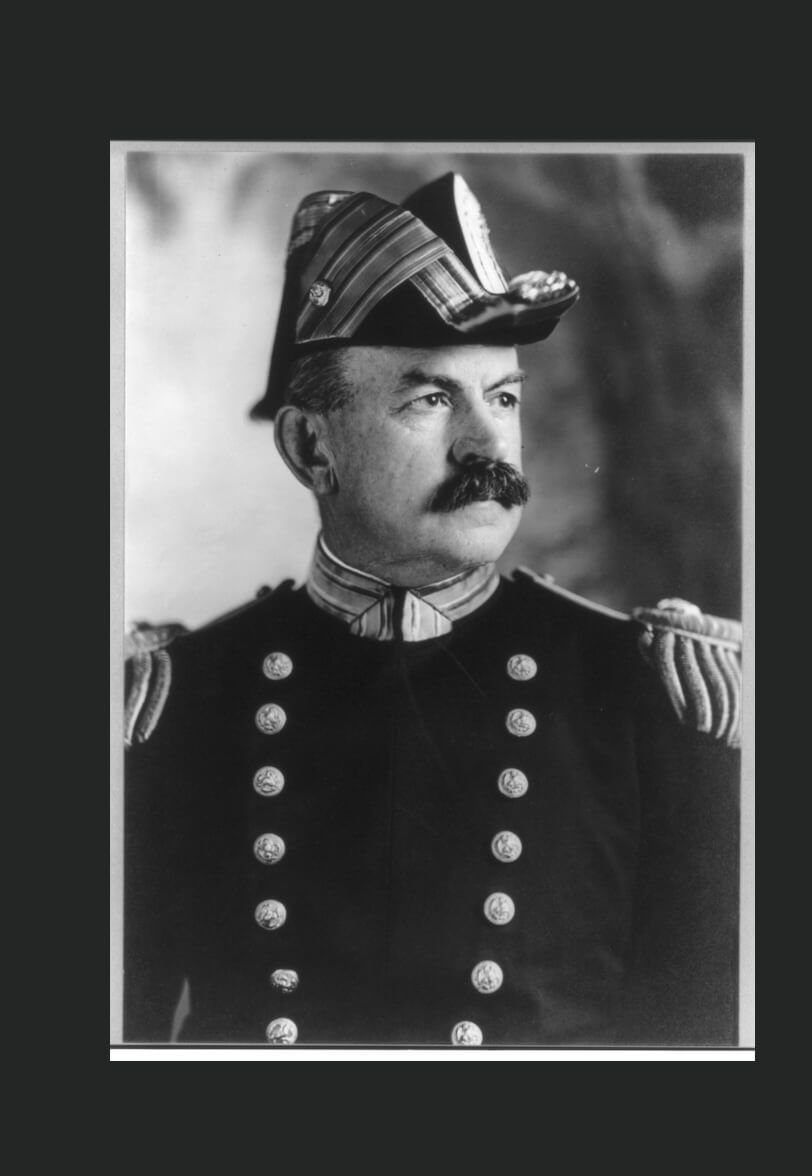

During World War II, thousands of American sailors served around the world on Fletcher-class destroyers, 175 of which were commissioned between 1942-1944. From Guadalcanal to Normandy and on to Tokyo, Fletcher-class destroyers represented a modern era of Navy ships. After service in three wars, the final Fletcher in the US Navy was decommissioned in 1971. Like many of the ships of the class, the lead ship, USS Fletcher (DD-445), was named for a Medal of Honor Recipient, Rear Admiral Frank Friday Fletcher.
The namesake of one of the Navy’s most iconic ship classes was born in landlocked Oskaloosa, Iowa, in 1855. Frank Fletcher, the youngest son of James and Nancy, was called “my little man Friday” as a nod to the day of the week on which he was born. Given no middle name, the nickname became official when he earned a place at the US Naval Academy at just 14 years old. James Fletcher died when Frank was just 7, and an older brother escorted him to the Academy in Annapolis, Maryland. While signing the younger Fletcher in, he added Friday as a middle name. The childhood moniker stuck and eventually helped distinguish Frank Fletcher from his nephew Frank Jack Fletcher, who followed in his uncle’s footsteps. But by the time his nephew entered the Naval Academy in 1902, the elder Fletcher required no nickname to distinguish himself among Navy brass.


After the usual rotation aboard various ships for junior officers, Fletcher served for a brief period as the Assistant Chief of the Bureau of Ordnance. Ordnance was where Fletcher excelled, and throughout his time in the Navy, he created many improvements in naval gunnery. The most notable was the Fletcher rapid-fire breech mechanism, which allowed large-caliber naval guns to be fired at a significantly faster rate. The evolution of his mechanism would be vital to the Navy during World War II. For someone with Fletcher’s talents with ordnance, his time in the Navy was aligned with major developments, including the torpedo, to which he contributed improvements to their use.
Fletcher’s naval career took him around the world, from exploring the Tuscarora Deep off Japan to an expedition in South America. Throughout his career and his travels, Fletcher built a reputation as a sailor and scholar but was also known for a keen sense of humor. During the conflict at Veracruz, Marine Corps Major Smedley Butler (who would earn his first Medal of Honor at Veracruz) served with both Fletchers. Of the elder, he remarked, “One had to become acquainted with Admiral Fletcher to appreciate his sterling character and his charm. He was a grand old sea dog.”
It was for his leadership at Veracruz that America would get acquainted with the “grand old sea dog.” In the spring of 1914, Rear Admiral Fletcher was in command of the Fourth Division of the Navy’s Atlantic Fleet. The fleet had arrived off Veracruz in October to protect Americans living in Mexico as the country fell into a civil war. On April 9, 1914, eight sailors and an officer went ashore near Tampico to pick up cans of gasoline. As two remained behind with the boat to be loaded, Mexican soldiers soon arrived and ordered all of the men to go with them to the nearby headquarters of their colonel. Though quickly released to continue their work, they were not allowed to leave the warehouse where the gasoline was stored without permission from a general. The incident escalated, and Fletcher’s counterpart, Rear Admiral Henry Mayo, demanded an apology. Soon, President Woodrow Wilson was involved.
Fletcher did not believe the incident to be significant, but Wilson was determined not to allow for slights against his countrymen, and to prevent weapons and munitions from being delivered to Mexican forces, upholding an arms embargo the United States had implemented. With only approval from the House of Representatives, Fletcher ordered the seizure of the customs house in Veracruz to prevent the weapons shipment from reaching Mexican forces. On April 21, Fletcher sent about 800 sailors and Marines ashore. The fiercest resistance came from cadets at the Veracruz Naval Academy. After shelling the academy, additional units landed, and with a strength of 3,000 sailors and Marines, the US forces gained control of the city.
Over the next six months, US forces occupied Veracruz. Twenty-two US personnel were killed in the effort to secure Veracruz. Fifty-six Medals of Honor were awarded. Among them were Butler, Frank Jack, and Frank Friday Fletcher. All three received the Medal the following year after Congress finally passed legislation making Navy and Marine Corps eligible for the Medal of Honor. For their actions at Veracruz, 38 Navy and Marine Corps officers were awarded the Medal. Many were awarded for leadership, and not necessarily for actions “above and beyond,” setting a precedent for awarding the Medal to naval officers for leadership in combat.
The following year was a difficult one in the career of Friday Fletcher. Serving as the Commander in Chief, Atlantic Fleet, Fletcher led the force in two major war exercises, though he “lost” in both. War had broken out in Europe, and despite a desire for America to remain isolationist, it was only a matter of time before the country was drawn into war. Fletcher left sea duty in 1916 and served on the General Board for the Navy through World War I. He retired in 1919 and died in 1928.
On June 30, 1942, Fletcher’s widow, Susan, served as the sponsor for USS Fletcher (DD-445) at its commissioning. Nicknamed the Fighting Fletcher, the ship’s patch boasted that it was “first in class.” Within months, USS Fletcher departed for the Pacific, where the ship participated in the Naval Battle of Guadalcanal, supported landings at the Gilbert Islands, and the Marshall Islands campaign in 1944. In 1980, a new USS Fletcher (DD-992) was commissioned, this time honoring Frank Jack Fletcher and continuing the Fletcher legacy.
Kali Schick is Senior Historian for the
National Medal of Honor Museum