


Related posts


The tiny settlement that formed around the tracks became known as Arlington. Like many communities born near the rails, it relied on the railroad, creating a natural supply and demand on previously empty land. But you can’t have a train without tracks.
Laying the Groundwork
In 1871, Congress chartered the Texas and Pacific Railway Company (T & P Railroad) to build an east-west route connecting Marshall to El Paso. The line was expected to link Dallas and Fort Worth by 1874. Construction began in 1872, reaching Dallas by July 1873, but quickly halted due to economic factors. Progress stalled at Eagle Ford near Grand Prairie—less than 30 miles short of Fort Worth—where the tracks sat idle for three long years.
Construction finally resumed in early 1876 under strict threats to revoke funding if the rails didn’t reach Fort Worth by mid-year. Despite heavy spring rains, the community rallied, working alongside crews into the night by lantern light. Following two brief extensions, though cutting it close, the railroad was finally ready to connect the two major North Texas cities.
Changing the Map
Locally, the railroad was initially expected to pass through Johnson Station, a thriving stagecoach stop with an established general store and post office. However, a local landowner reportedly refused to sell, and the area was flood-prone, forcing surveyors to find another route westward.
The new site chosen sat three miles north of Johnson Station. When the railroad sought help platting this half-mile-square settlement, they turned to Reverend Andrew S. Hayter (1818–1900), a Presbyterian preacher and surveyor who served as a consultant and resource. The railroad offered to name the town “Hayterville” in his honor, but “Arlington” was suggested instead to honor Robert E. Lee’s Virginia estate. Other nearby settlements quickly became obsolete as folks moved closer to the tracks.
The Arrival
People traveled for miles by wagon and horseback to witness the arrival. For many, it was their first time seeing a train. Folks dressed in their finest and brought baskets of food, clustering near the track in a grand, celebratory atmosphere.
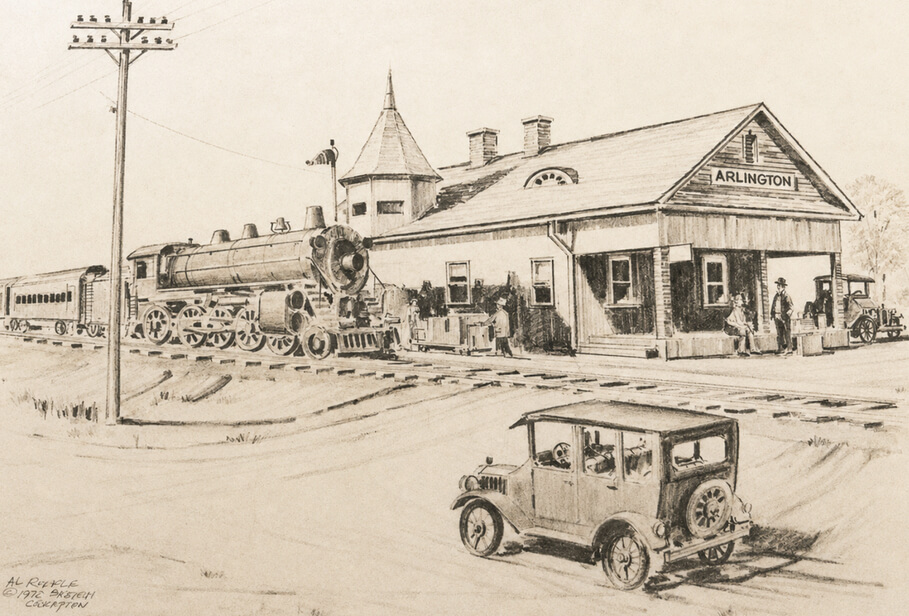
Painted black with gold striping, polished brass, and a red cattle guard, Engine #20 of the Texas & Pacific Railroad rumbled to a stop in what is now Arlington. After a brief visit, the train headed west toward Fort Worth to an enthusiastic welcome.
The Heart of the Town
The depot rapidly became a vibrant social and commerce hub, serving as a crucial artery for people, freight, mail, and vital information. By the early 1900s, six daily trains stopped in a bustling Arlington of 1,000 residents and five cotton gins. Decades later, many young men left via these same tracks for World War II. In the early 1950s, the station served as a community rallying point to ship supplies, aid, and care packages to Bad Königshofen in Germany—Arlington’s Sister City to this day.
Arlington had three train stations over the years. The original (1877–1902) was lost to fire. Its replacement (1904–1956) was an iconic brick structure featuring a prominent tower, serving Arlington the longest. The final depot (1956–1969) handled freight and passenger lines. After passenger service was discontinued in 1969, the building was demolished, though freight continued to be shipped, and a surviving section of the wooden platform was honored with a Texas Historical Marker in 2023.
A Lasting Legacy
Railroads were vital to western expansion, though our reliance on them diminished by the 1950s with the rise of automobiles and aviation. Still, the early rails transformed the landscape and birthed a new era.
Arlington is a true railroad town that owes its existence to the rails. Long known as just a stop between Dallas and Fort Worth, it carved out its own unique identity through destiny and determination. Freight trains still rumble through town daily; one of the largest users is the General Motors Assembly Plant, which uses the rails to ship vehicles. Even the oldest ride at Six Flags is the train—proving that a slow-moving locomotive is still revered as a nostalgic throwback to our roots.
Without the railroad, Arlington may never have grown into a city of 400,000 people spanning nearly 100 square miles. Transportation in general, and the arrival of the iron horse in particular, changed the course of our history forever—a milestone celebrated on July 19, 2006, when the “City of Arlington” Texas Historical Marker was dedicated for our 130th anniversary.
Today, these iron rails remain exactly where they were placed in 1876. While the city has evolved all around them, nothing else has remained so constant. They have been here from the very beginning, serving as a tangible, lasting link to our past.